
The Best Indoor Activities to Tire Out a Reactive Dog
Beyond the Walk: Our Favourite Science-Backed Indoor Activities for Reactive Dogs (Tested in Our Home)
Walking a reactive dog isn't always the decompression it's supposed to be, and instead, it can be a high-stress cortisol spike for both ends of the lead.
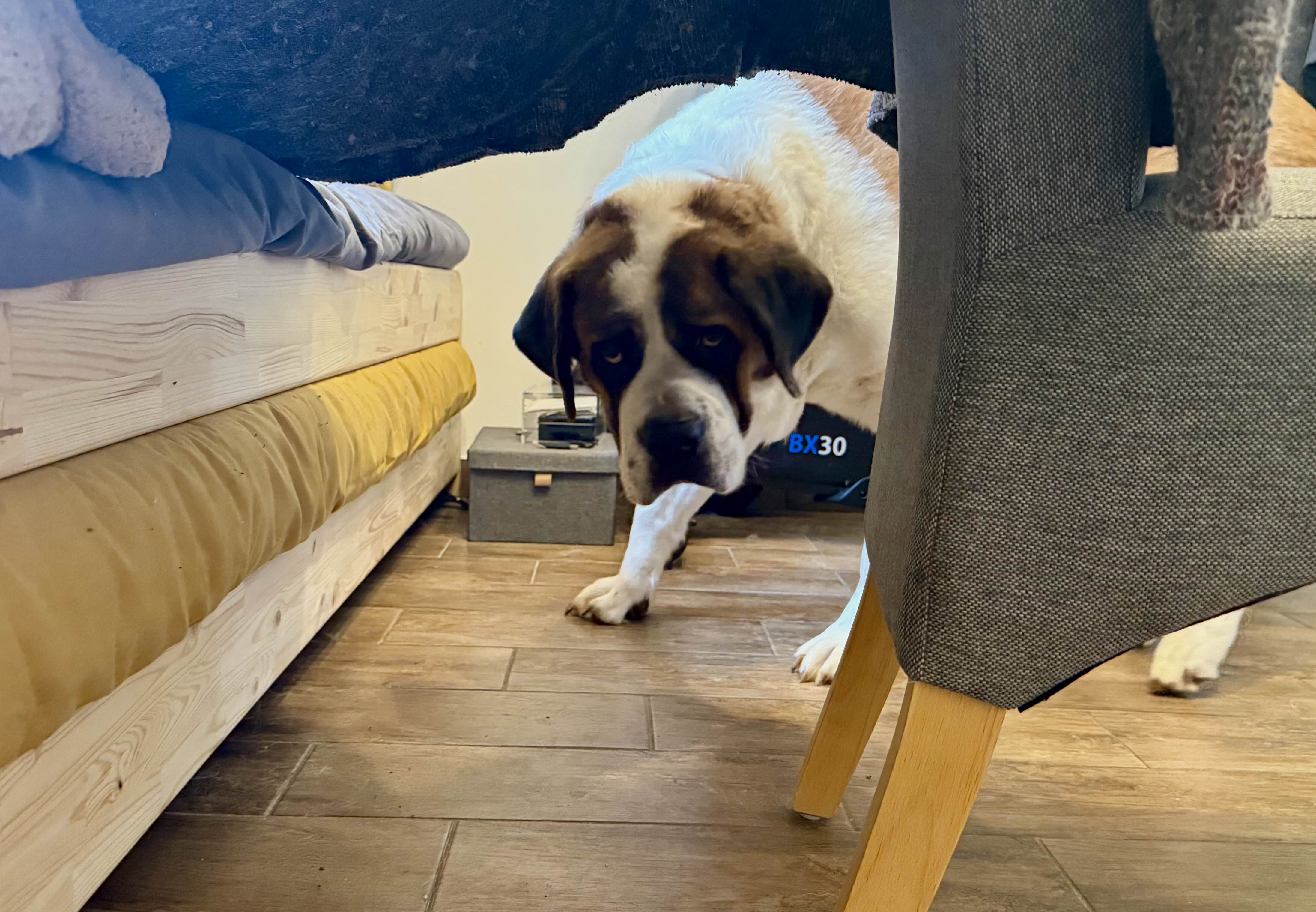
I've owned a mixture of working-line and reactive dogs for nearly two decades and Jess, our Saint Bernard, has been the biggest challenge.
At the peak of her reactivity, we dealt with major lunging and barking at neighbourhood triggers (of which there were many) and we were exhausted trying to acclimatise her to a new neighbourhood. After a few sessions with a behaviourist, we realised that sometimes the kindest thing you can do for your dog's nervous system is to stay inside.
Most "indoor activities" focus on physical movement, but for our reactive dogs, we should actually be focusing on lowering cortisol levels through scent-work and impulse control.
In this blog, I'm sharing the exact five-game circuit we use to provide mental enrichment that actually tires out a dog more effectively than an hour-long walk.
The perfect thing about these games? There's not a single trigger in sight.

Why Indoor Activities Matter
For our reactive dogs, outdoor triggers can quickly turn a routine walk into an extremely stressful and challenging situation. These reactive episodes can elevate your dog's cortisol levels significantly, which further influences how your dog reacts to triggers and impacts the time it takes them to settle afterwards.
Read: Understanding Cortisol Levels in Your Reactive Dog
Crowded areas, unexpected noises, or an unwanted interactions can quickly escalate your dog's anxiety. This is why having a go-to list of indoor activities is important for any reactive dog owner.
These activities help manage energy levels, reduce stress, and improve their overall wellbeing. Most importantly, these are activities that we have tried and tested, and truly consider essential in our own dog's behaviour modification.
Interactive Puzzles: Moving Beyond the Basics
Puzzle toys are one of the best ways to keep your dog's mind sharp and engaged. However, if your dog solves a standard Kong in two minutes, they aren't being tired out.
While you should always provide your dog with physical exercise, incorporating a puzzle into your reactive dog's daily routine can help their problem-solving skills, focus, and function as a tool for mental stimulation.

We use puzzle toys every lunchtime feeding session for our two dogs, which helps them immensely with their afternoon energy-excess.
Recently, we actually noticed our reactive dog stopped her "window watching" sessions after lunch, simply because she's too tired to focus on what was happening out on the street after an interactive puzzle.
Our Interactive Puzzle Recommendations for Reactive Dogs Available in the UK
Tower Tube Spinning Puzzles
These are genuinely some of our favourite puzzle toys on the market because almost any dog can eventually understand them.
Tube spinning puzzles help with the conditioning of your dog's legs, dexterity, and focus. It's amazing watching your pup develop an understanding to paw at specific tubes, or that the cap needs to face towards the ground.
Our Shiba Inu is an expert at this interactive puzzle, but it still takes him about 10 minutes to completely empty the tubes of his food. As he is a food-oriented dog, we use his standard kibble in this puzzle toy and it works perfectly.
We recommend:

Multi-Layered Puzzle Boards
In our training sessions with our dogs, we have found that Multi-Layered Puzzle Boards are better for incorporating "Find It!", which is great for the beginning stages of nose work.
Interactive puzzle boards require your dog to use their sense of smell, their paws, and their noses to move pieces of the puzzle, which helps build your dog's confidence through the art of scavenging.
Puzzle boards vary in difficulty, so if your dog has never tried one, I do suggest beginning with something simple and gradually increasing the challenge as your dog gets better at solving them.
Simple Puzzle Board Recommendations:
Intermediate Puzzle Board Recommendations:
Advanced Puzzle Board Recommendations:
Puzzle boards are fantastic tools for keeping your reactive dog entertained while you're working from home or need a few quiet moments.
They're a great distraction for dogs that are easily triggered by external noises or movements, and can be used for building up your dog's tolerance to outdoor spaces.
During the early days of our confidence-building training, we would bring puzzle boards on walks with us. We would place one down in a green space with triggers at a safe distance, so that our reactive dog could focus her energy on something other than the trigger and create an association of "scary outside world" with positive interactions and treats.

Scent Games and Advanced Nose Work: Why "Find It!" is Better than a Walk!
Did you know that nose work induces positive judgment bias in our dogs?
... And that 10 minutes of intense sniffing is equivalent to a thirty-minute walk in terms of mental fatigue?
If not, now you do!
By allowing our dogs to use their noses and performing more "foraging" time, their welfare is improved. Scent games are an excellent way for reactive dog owners to provide mental and physical stimulation that aligns with developing an optimistic attitude for your dog.
While we enjoy using products designed for snuffling and nose work indoors, one of the best ways to encourage your dog to snuffle is by feeding them in the garden.
Using dry biscuits, you can establish a nose work game by (litterally) throwing your dog's food throughout the grass, scattering it in an even distribution, accompanied with "Find it!".
If you don't have a garden, you can do this during a walk by bringing a small bag of food, finding a quiet, grassy area, and scattering the biscuits while your dog is attached to a long line.
Alternatively, using a snuffle mat is a fantastic option for beginner indoor nose work.
-p-1080.png)
Our Scent Games Product Recommendations
Fabric Snuffle Mats
One of our favourite beginner products for scent games is a good old snuffle mat.
If you have a sewing machine and some old fabric that you're not afraid to upcycle (thicker is ideal, but not essential), you can make your own snuffle mat.
However, we have a couple of favourites that are priced competitively and are a good size for all breeds of dogs.
We recommend:

Tactical Tug-of-War (With a Training Twist)
Tug games aren't just about strength. For our reactive dogs, they're about impulse control.
We love using tug-of-war as a way to practice the "Leave it!" or "Drop!" commands.
By asking your pup for a "Sit" in the middle of a super high-arousal game, you are teaching your dog how to move from a red zone of high arousal and energy back to a green "calm" zone instantly.
So not only is tug-of-war a great way for your dog to burn off physical energy, but it can help reinforce training commands.
In addition to being a great training tool through play, tug-of-war is a wonderful activity to help solidify the bond between you and your pup. There are tonnes of different tug-of-war toys on the market, so pick one that you think your pup will enjoy!
The DIY 'Decompression' Agility Course
You don’t need a backyard to create an agility course, just a little creativity!
We use household items like chairs and blankets to create "visual barriers", and brooms and mop handles to design jumps and weave poles.
It may seem a little silly at first, but creating a DIY Agility Course is a tonne of fun for both you and your pup.
This indoor activity can also be recreated outside: it's fun and provides a full-body workout and some much-needed mental stimulation at the same time. Building a course is a great way to keep your dog physically active and mentally sharp without leaving the house (or garden).
Indoor Fetch to Burn Off Extra Energy
While our resident reactive pup isn't a huge fan of outdoor fetch, she actually loves chasing a soft toy around the house when we toss it.
So if you don't have enough space in your garden, indoor fetch can be a great way to burn off some energy.
Fetch is a fantastic physical activity that can tire out even the most energetic dogs. Plus, the repetitive nature of the game helps reinforce positive recall behaviours alongside commands like "Bring it here!" and "Come!"
Indoor Ball Product Recommendation
Our dogs are obsessed with this Chuckit! Indoor Ball.
Sometimes they will just carry it around, other times they'll play tug-of-war with it, but it was originally purchased with the intent of using it solely for indoor fetch - and it does do a great job!
It's soft, lightweight, and is specifically designed for indoor play, making it a safe option for a game of fetch in the living room.

Creating a Safe Home Environment
When it comes to managing a reactive dog, creating a safe and peaceful home environment is key.
For more tips on making your home a sanctuary for your reactive dog, check out our article on Creating a Safe Home Environment for Reactive Dogs.
If you’re looking for more strategies to make life with your reactive dog easier, don’t miss our guide on Living with a Reactive Dog: Strategies for Stress-Free Coexistence.
So, try out some indoor activities with your reactive dog!
Keeping a reactive dog calm and content indoors can be a challenge, but with the right activities, you can turn those chaotic high-energy moments into positive experiences for the entire family.
Whether you're working on mental puzzles, playing scent games, or just enjoying a game of tug-of-war, these indoor activities will help tire out your reactive dog and keep them happy.
Remember, it's all about finding the right balance of physical and mental stimulation to keep your dog engaged and calm. So, the next time you're stuck indoors, give one of these activities a try and watch your reactive dog thrive!
 Meet the Author
